

MongoDB Atlas
Setup guide for MongoDB Atlas as a Streamkap source, covering Atlas database user creation, the signal collection, and connection string retrieval.
Prerequisites
- MongoDB version ≥ 5.0
- A MongoDB user with sufficient privileges to create database users and collections
MongoDB Atlas Setup
1. Grant Database Access
- Configure one of the Connection Options to ensure Streamkap can reach your database.
2. Create Database User
MongoDB Atlas
-
Log in to MongoDB Atlas and navigate to the MongoDB cluster.
-
In the left-hand navigation menu, go to Security > Database Access.
-
Click New Database User.
-
Choose the password authentication method.
-
Enter the username and password for the new Streamkap user (e.g.
streamkap_user). -
In the Database User Privileges drop-down menu, select Grant Specific User Privileges.
-
Under Specific Privileges, add the following roles/privileges:
readAnyDatabasereadon thelocaldatabase
-
Click Add User.
MongoDB Shell
- Using MongoDB Shell, connect to your primary node or replica set.
- Create a user for Streamkap using the script below. Replace password with your choice.
use admin
db.createUser({
  user: "streamkap_user",
  pwd: "{password}",
  roles: [ "readAnyDatabase", {role: "read", db: "local"} ]
})
3. Enable Snapshots
To backfill your data, the Connector needs to be able to perform snapshots. See Snapshots & Backfilling for more information.
You will need to create the collection and give necessary permissions to the streamkap_user. The Connector will use this collection for managing snapshots.
This collection can exist in a different database (on the same MongoDB cluster) to the database Streamkap captures data from.
MongoDB Atlas
-
Navigate to the MongoDB cluster.
-
Navigate to Collections and create a new collection in the database by clicking the
+button next to the database name.- Name the collection
streamkap_signal. - Give the Streamkap user permissions to
readWriteon thestreamkap_signalcollection. - Return to the Database User Privileges drop-down menu, select Grant Specific User Privileges.
- Under Specific Privileges, add the following roles/privileges:
readWrite@{database}.streamkap_signal
- Under Specific Privileges, add the following roles/privileges:
- Name the collection
MongoDB Shell
db.createCollection("streamkap_signal")

db.grantRolesToUser("streamkap_user", [
  { role: "read", db: "{database}" },
  { role: "readWrite", db: "{database}", collection: "streamkap_signal" }
])
4. Heartbeats
MongoDB uses change streams to track changes. While change streams use resume tokens to track position, these tokens can expire or become invalidated—particularly on clusters with high write activity or when using custom aggregation pipelines that filter events.
Heartbeats ensure the Connector receives regular change events, keeping resume tokens fresh and providing liveness monitoring.
There are two layers of heartbeat protection:
Layer 1: Connector heartbeats (enabled by default)
The Connector periodically emits heartbeat messages to an internal topic, even when no actual data changes are detected. This keeps offsets fresh and prevents staleness.
No configuration is necessary for this layer; it is automatically enabled. We recommend keeping this layer enabled for all deployments.
Layer 2: Source database heartbeats (recommended)
You can configure regular updates to a dedicated heartbeat collection in the source database. This simulates activity, ensuring change events are generated consistently and resume tokens remain valid.
Since the MongoDB Connector doesn’t write directly to the database, you must configure a scheduled job to generate artificial traffic. For MongoDB Atlas, use Atlas Scheduled Triggers.
Create the heartbeat collection
Create a collection to store heartbeat documents. This can be in the same database you’re capturing or a dedicated streamkap database.
Using MongoDB Atlas UI:
- Navigate to your cluster and click Browse Collections
- Click Create Database or select an existing database
- Create a collection named
streamkap_heartbeat
Using MongoDB Shell:
use streamkap
db.createCollection("streamkap_heartbeat")
Grant permissions to the Streamkap user
Ensure the Streamkap user has read access to the heartbeat collection.
Using MongoDB Atlas UI:
- Go to Security > Database Access
- Edit the
streamkap_user - Under Specific Privileges, add:
read@streamkap.streamkap_heartbeat
Using MongoDB Shell:
db.grantRolesToUser("streamkap_user", [
  { role: "read", db: "streamkap" }
])
Create an Atlas Scheduled Trigger
- In MongoDB Atlas, go to App Services (or Triggers in the left menu)
- Click Create a Trigger
- Select Scheduled trigger type
- Configure the trigger:
- Name:
streamkap_heartbeat_trigger - Schedule Type: Basic
- Repeat once by: Minute
- Every: 1 minute(s)
- Name:
- In the Function section, select Function and create a new function:
exports = async function() {
  const serviceName = "mongodb-atlas"; // Your cluster service name
  const database = "streamkap";
  const collection = "streamkap_heartbeat";

  const coll = context.services
    .get(serviceName)
    .db(database)
    .collection(collection);

  const result = await coll.updateOne(
    { _id: "heartbeat" },
    {
      $set: {
        last_update: new Date()
      }
    },
    { upsert: true }
  );

  console.log(`Heartbeat updated: ${JSON.stringify(result)}`);
  return result;
};- Click Save
5. Obtain Connection String
You’ll need the connection string for setting up the Connector in Streamkap.
MongoDB Atlas
- Log in to MongoDB Atlas and navigate to the cluster to which Streamkap should connect.
- Click Connect.

- Click Connect your Application.

- Copy the connection string.
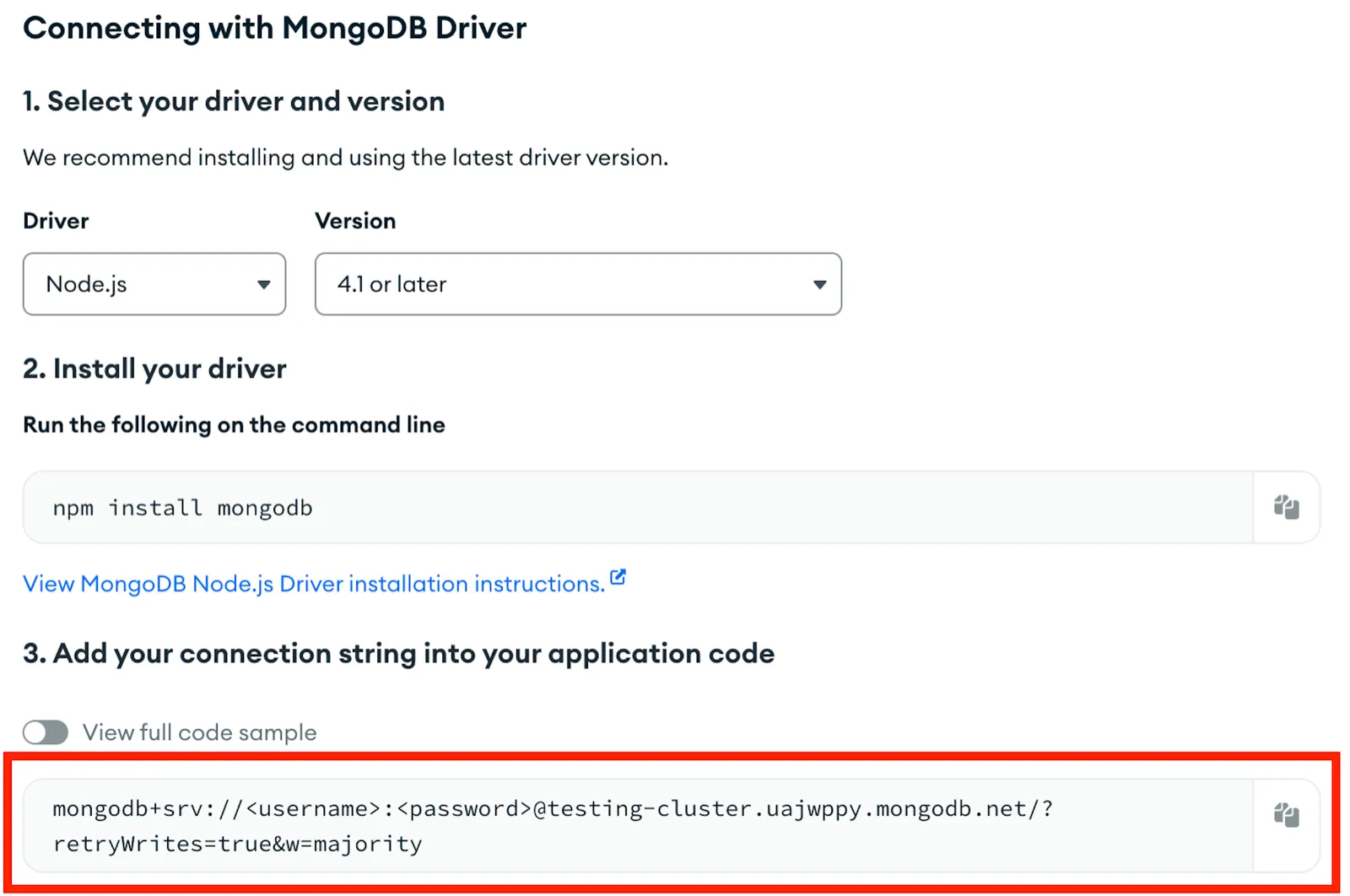
MongoDB Shell
-
Connect to your replica set or primary node using the MongoDB shell as an Admin user.
-
Run
db.getMongo()method to return your connection string.-
We recommend the connection string have the following parameters. They will be added automatically if not included:
w=majorityreadPreference=primaryPreferred
-
Streamkap Setup
Follow these steps to configure your new connector:
1. Create the Source
- Navigate to Add Connectors.
- Choose MongoDB.
- Select MongoDB Atlas.
2. Connection Settings
-
Name: Enter a name for your connector.
-
Connection String: Copy the connection string from earlier steps but replace username and password in the string with the one you created earlier.
-
Array Encoding: Specify how Streamkap should encode MongoDB array types.
Arrayencodes them as a JSON array but requires all elements in the arrays to be of the same type e.g. array of integers.Array_Stringencodes them as a JSON string and must be used if the MongoDB arrays have mixed types. -
Nested Document Encoding: Specify how Streamkap should encode nested documents.
Documentencodes them as JSON objects but may be problematic for complex (e.g. multiple levels of nested sub documents and arrays, sub arrays of nested documents) documents.Stringencodes them as a JSON string and we recommend it if the MongoDB nested documents are complex. -
Connect via SSH Tunnel: The Connector will connect to an SSH server in your network which has access to your database. This is necessary if the Connector cannot connect directly to your database.
- See SSH Tunnel for setup instructions.
3. Snapshot Settings
- Signal Collection: Full path to the signal collection including database and collection name (e.g.,
streamkap.streamkap_signal). This collection is used for incremental snapshotting. See Enable Snapshots for setup instructions.
4. Database and Collection Capture
- Add Database/Collections: Specify the database(s) and collection(s) for capture.
- You can bulk upload here. The format is a simple list of databases and collections, with each entry on a new row. Save as a
.csvfile without a header. - If you configured Layer 2 heartbeats, include the heartbeat collection (e.g.,
streamkap.streamkap_heartbeat). See Heartbeats for setup instructions.
- You can bulk upload here. The format is a simple list of databases and collections, with each entry on a new row. Save as a
5. Recovery Settings
These settings live in the Advanced section of the form and are off by default.
- Invalid Resume Token Recovery: What the connector does when MongoDB rejects the change stream position it stored — for example
ChangeStreamFatalError(error 280) after the oplog rotated past that position.- Fail the connector (default): The connector stops and the connector failure alert fires. Getting it running again needs a manual offset reset.
- Skip to latest, keep streaming: The connector discards the rejected position, reopens the change stream at the current end of the oplog, and carries on. Changes made during the gap are not captured, and the MongoDB resume token recovered alert fires with the gap window so you can backfill it with a snapshot.
- Max Consecutive Recoveries: Circuit breaker for the option above.
-1(default) allows unlimited recoveries. A value above0stops the connector after that many recoveries with no successful events in between; the count resets as soon as events flow again.
Click Save.